
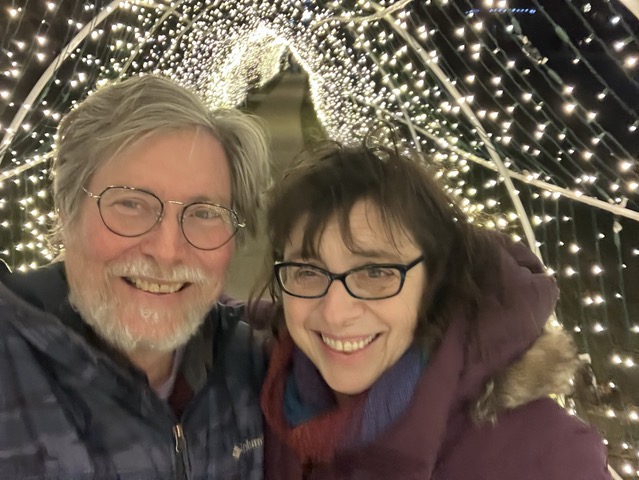
OK, it’s a little bit of a stretch to write about Ken Lassman and call it a “Fairview Profile”—but I think the term fits. After all, for several years, Ken’s work has been featured on page four of the Enterprise: “The Kaw Valley Almanac—Fairview Edition.” I hope you read it religiously, as I do. Not only does it give you the basics—sunrise/sunsets, phases of the moon, daylight and darkness—specifically for Fairview, but it includes highly readable narratives about nature, about the habits of the plants and animals that surround us and whose lifecycles throughout the year we should observe and appreciate.
Ken is an occupational therapist by training, a credential earned after also graduating with an anthropology degree from KU, and he has also been called a “nature essayist.” He notices the world around him, and has been writing about it for many years in his weekly “Kaw Valley Almanac,” published in the Lawrence Times, and, since March of 2023, in his biweekly “KVA—Fairview Edition” for the Enterprise. He is also the author of two books—Seasons and Cycles: Rhythms of Life in the Kansas River Basin (1985), and Wild Douglas County (2007) [available in the shop on this website.]
A couple of weeks ago, Sacie asked Ken “How in the world” did he know so much about nature and what is going on all around us? This was Ken’s response, in part: “So how did I learn as much as I have? Curiosity and awareness, I guess. I was fortunate enough to develop some handy ways to catalogue my observations and accumulate them in a way that isn’t exactly science…, but is focused more on seeing how the pieces fit together, which around here is unlike any other place on the planet. (The same goes for any other part of the planet, which I think is pretty cool.) The seasons are literally a cycle that repeats itself every year, and, like the earth revolving around the sun, has no starting or ending point. Our local pattern of seasons is unlike any other place on the planet, meaning it is central to what makes this place uniquely what it is. Furthermore, even with a changing climate, the sequence of this unfolding pattern is pretty much the same as what the first settlers saw, or the Kanza tribe saw before them, or what the hunter-gatherers who lived in this area thousands of years before the Kanza saw. Observing these cycles is a fun and lifelong way to place your plant or animal observations into the time/place context of all the other plants and animals who are living their lives in this grand unfolding pattern.” Ken added that, “I think if folks put place-based wisdom of nature at the top of our daily awareness instead of at the bottom or not even in the room, we’d live in a much more interesting, vibrant and healthy planet.”
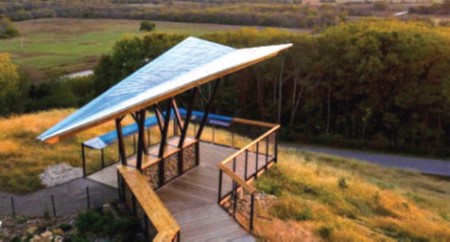
Ken spent most of his boyhood on a small acreage just south of Lawrence, the Wells farm. He is a proud fifth-generation Kansan. The land, which he purchased from other family members and has converted to a conservation easement, surrounds what is known as Wells Overlook, a 17 acre parcel donated by Ken’s grandfather to Douglas County in 1971, and now a lovely spot from which to view the Wakarusa and Kaw valleys and Lawrence in the distance.
See below: the pavillion was built by KU architecture students in 2021.
Ken grew up loving the outdoors, and with a native curiosity that he allowed to be his guide. From just being outside, and camping, he began to develop a personal but systematic way of looking at nature and thinking about how he and his fellow humans ought to relate to it.
While at KU, studying for his anthropology degree, he was a member of an informal “bioregionalist” group, bioregionalism being based on the idea of existing sustainably “within the ecological carrying capacity of where you live.” In other words, in order to appreciate your world, and live in it respectfully, you need to understand the ecology of where you live. And try to understand as well, what is happening in nature all around you. This obviously would be different from, say, the Pacific Northwest, or Florida, or Southeast Asia or anywhere else on earth.
Another member of that bioregionalist group at KU, was Caryn Mirriam-Goldberg, a student from Brooklyn and a woman whose interests and sensitivities fitted nicely with Ken’s. They met in 1982 and married in 1985. An oft published writer, she is a former Poet Laureate of Kansas.
A “student” for many years, Ken has become a leading expert on the natural phenomena of NE Kansas. He has observed, noted and recorded, measured and compared, and learned in impressive depth the secrets of the seasons and the cycles of life of this particular part of the world. (Just as an example, he noted in our last “Kaw Valley
Almanac, Fairview Edition,” that turkey vultures would be returning either that week or the following week—and darned if they didn’t.)
There is a lot of accumulated knowledge and more than a little bit of wisdom included in every iteration of “Kaw Valley Almanac, Fairview Edition,” always carefully curated by Ken to highlight what can be seen in our area, if we look. We hope you enjoy it and appreciate it as much as we do.
—First printed in The Fairview Enterprise, Vol. 137, No 7, Wed April 1, 2026 (published biweekly in Lawrence, Kansas) & used by permission from David Lambertson, Publisher.