
“These were the contradictions we faced in our time. And this is what we did about it. What are the contradictions you face today? And what will you do about it?“
Narciso Aleman (a founder of La Raza) to current students at Chicano colleges.
When my wife Ellen and I moved to Milwaukee in 1978, the main political contradictions here were the racism of the Police Department and Police Chief Harold Brier; the Democratic Mayor of Milwaukee, Henry Maier, calling significant industrial smokestack pollution “air with character;” and public schools in crisis. By the mid-1980s the Rust Belt Recession hit hard—fifty factories closed, 20,000 jobs lost—followed by marriages breaking up, home foreclosures, youth hopelessness, and rising crime rates. For a city our size, our metro area’s environmental impact would have been using roughly every day: 6000 tons of fossil fuels, 1330 tons of food, 4330 tons of water, and putting out 330,000 tons of sewage and 18,000 tons of carbon dioxide. And the public schools overall were becoming dysfunctional (less than 50% high school graduation rate and math and reading test scores well below 50% competency).
“People are the greatest resource being wasted in cities.”
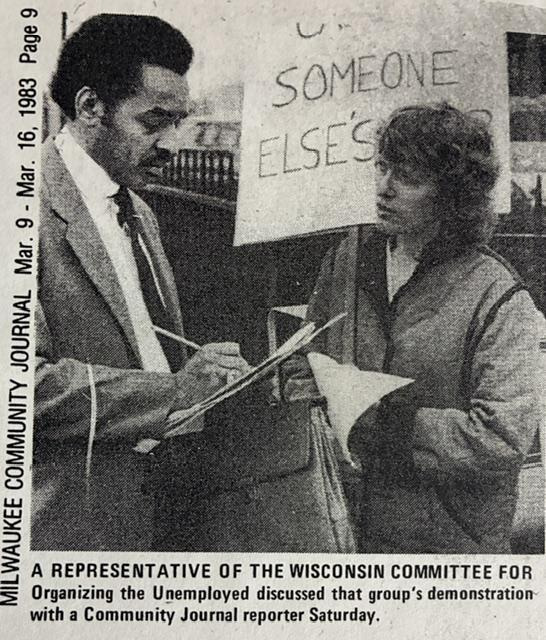
Slogan of the “Wisconsin Committee to Organize the Unemployed (WCOU)” mid-1980s Rust Belt recession. Educational pickets on Disinvestment, Robotization, No Overtime in manufacturing plants in order to create more jobs; allow access to factories scrap metal piles for recyclers. This is the work Ellen Smith (pictured below) and Rick Whaley did together before forming Milwaukee Area Greens with Bruce Hinkforth who we had met outside his food co-op where, one weekend day, WCOU had a “Ring the Neck of a Capitalist” info table— ring toss around soda bottles with pictures of local manufacturing CEOs.
It’s not how many people live in a city. It’s how people live in a city.
Gary Snyder
Milwaukee Area Greens (MAG) (1988-2000) urban issue-organizing Task Forces, included Pesticides (solution: Natural Landscaping) and Dioxins, evolving into Toxic Freeze Coalition with mainstream environmental groups; Light Rail/Mass Transit; Free Trade vs. Fair Trade; Urban Green Spaces; Water Quality and later Kids for Clean Water. Regular Study Groups beginning with The San Francisco Green City Program. We also hosted Stephanie Mills 1995 reading and book signing for In Service of the Wild: Restoring and Re-inhabiting Damaged Spaces. Other study groups over the next ten years included books by Susan Meeker-Lowry, Paul Hawken, eco-psychologist Theodore Roszak, David Korten, and Frances Moore Lappé and Rachel Shurman on population.
“Of all the arts of peace-making, gardening is the chief.”
Merlin in The Mists of Avalon by Marion Zimmer Bradley
Milwaukee Area Greens (MAG) supported farmers markets, Great Lakes CSA (Chicago-Milwaukee), and worked with Will Allen’s urban gardening “Growing Power” program and greenhouse/storefront. Opposed Bovine Growth Hormones (rBGH) in Wisconsin dairy cows. We helped promote Wendell Berry appearances in the Milwaukee area.
“I hope the stewardship movement, which is gaining momentum in Christian and Jewish circles, will continue to deepen its analyses and broaden its field of action.
Charlene Spretnak
MAG met regularly at Rev. Tim Perkins UCC in the Sherman Park neighborhood. Rev. John Gregg (Episcopalian) was a MAG member and on the Neighborhood Economic Development Task Force. MAG study groups on Starhawk, Eco-Feminism, Spretnak’s The Spirituality of Green Politics (1986). Lutheran Rev. Roosevelt Morgan. MAG promoted Gamaliel Chairs for Peace and Justice (an Our Saviors Lutheran Church project), including visiting lecturers from Highlander Folk School (Tennessee), Pastor Harald Wagner (a German Green and former political prisoner in East Germany), and eco-rabbi Arthur Waskow. Walt Bresette gave the keynote address at the 1996 North American Conference on Christianity and Ecology (NACCE) at the Milwaukee-area Archdiocese Cousins Center (City of St. Francis).
“The starting point for organizing the program content of education or political action must be the present, existential, concrete situation, reflecting the aspirations of the people.”
Paulo Freire
The process of letting people choose applied not only to Green members choosing what urban Task Force issues and northern Wisconsin solidarity that we would work on but applied also to the Education work that Milwaukee Area Greens did in our urban center. In our group, we had homeschoolers, public school teachers (and union reps), alternative schoolteachers and Illich de-schoolers. The Education Task Force was led by Ellen Smith (founder and director of Turning Point School in Milwaukee’s Westlawn Housing Project). For our MAG organizing, we helped set up Open Door Community Center at Hephatha Lutheran Church in the inner city and did an Earth Day celebration there and at another central-city church another year. Ellen wrote a proposal to use the abandoned, adjacent Hephatha elementary school building for a Small Schools project within Milwaukee Public Schools (MPS), with culture-based learning—reading and math, gardening, cooking and sewing, self-defense, and auto mechanics. Though Milwaukee School Superintendent Dr. Howard Fuller supported it, the Milwaukee School Board voted it down because the target group wasn’t big enough (emphasis added), the building needed repairs, and some opposed cultural community schools, even within MPS.
The Chicago Connection: Big Shoulders, Saul Alinsky, and Conscious Choice magazine
Bea Briggs did consensus training for MAG. The 1989 Green City Conference led off by urban heavyweights Peter Berg (San Francisco) and James Boggs (Detroit). Bruce Hinkforth and Rick Whaley took the Midwest Academy’s “Organizer Training” (Heather Booth’s neo-Alinsky community-organizing model—how to choose a winnable issue; develop a fallback position; coalition building). Then we set up that training for MAG and Wisconsin Green Party members. In the MAG circle whose hometown was Chicago were Jim Carpenter (Fair Trade and Mass Transit task forces), also a relentless peace organizer), and Milwaukee Earth Poet Dan Grego.
“Where there is singing, there is no fear. For evil people have no song.”
A German saying as told by Nóirín Ni Risin at the 1994 Ecology, Native Wisdom and Spirituality Conference in Killarney, Ireland
Among our songs were Claudia Schmidt, Milwaukee 1990 Earth Day Celebration Concert (when asked by a local TV reporter why she cared about the Earth, she replied, “I live here.”). David HB Drake, folksinger and maritime folklorist, house concert for MAG: Milwaukee watershed and Lake Michigan stories and songs. Annual Earth Poets’ events donated to Milwaukee Area Greens. All-Species Balls. Bonnie Raitt’s Milwaukee post-concert Reception/Benefit for Protect the Earth’s clean water work in northern Wisconsin. Milwaukee Area Greens had a literature table at Milwaukee Symphony Orchestra’s “Concert for the Amazon Rainforest.”
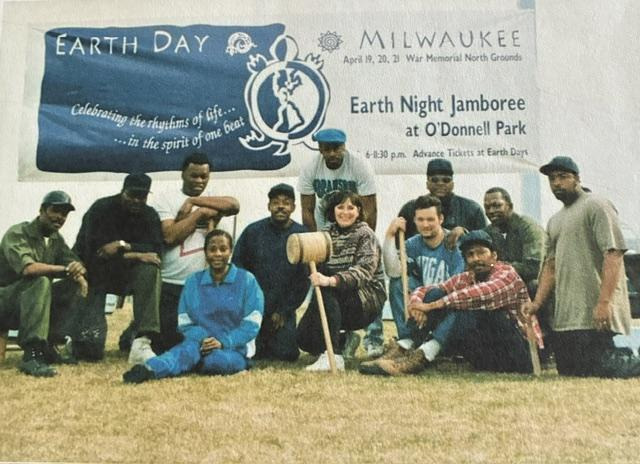
Pictured below, Kira Henschel, center, coordinator of Milwaukee Earth Day 1996 with Vets Place Central who set up and participated in Earth Day 1996.
“If you say something long enough, it becomes fashionable.”
Steven van Zandt (musician, activist)
One week before Earth Day 2000, I [RW] and MAG were run out of Wisconsin Green Party (WGP) by Madison Left Greens who vetoed and rewrote the MAG Green City “Vision for the Urban Crisis Center” in the WGP platform, though they had never once been to Milwaukee to support our movement work and lacked, in Madison, any discernable group practice or elected leadership. The national Left-Green Caucus played a similar role in GPUS, vis-à-vis movement-activist local groups vs. electoral chapters. If you have a Labor Party ideology, why aren’t you in the Labor Party, instead of running Green founders and organizers out of the party?
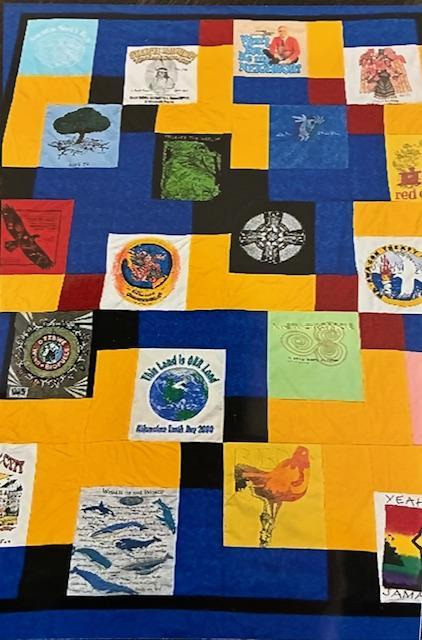
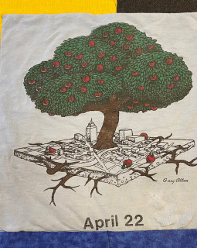
Rick’s 2nd political t-shirt Quilt