Bioregional congresses, started in 1984, have brought together people practicing and developing ways to reweave themselves into the bioregions (life + region) where they live. Acting on the premise that where we live has a lot to show us about how to live, bioregionalists develop a deep relationship with the local web of life to inform how to live sustainably, promote local self-sufficiency, and recognize our interconnection with the earth.
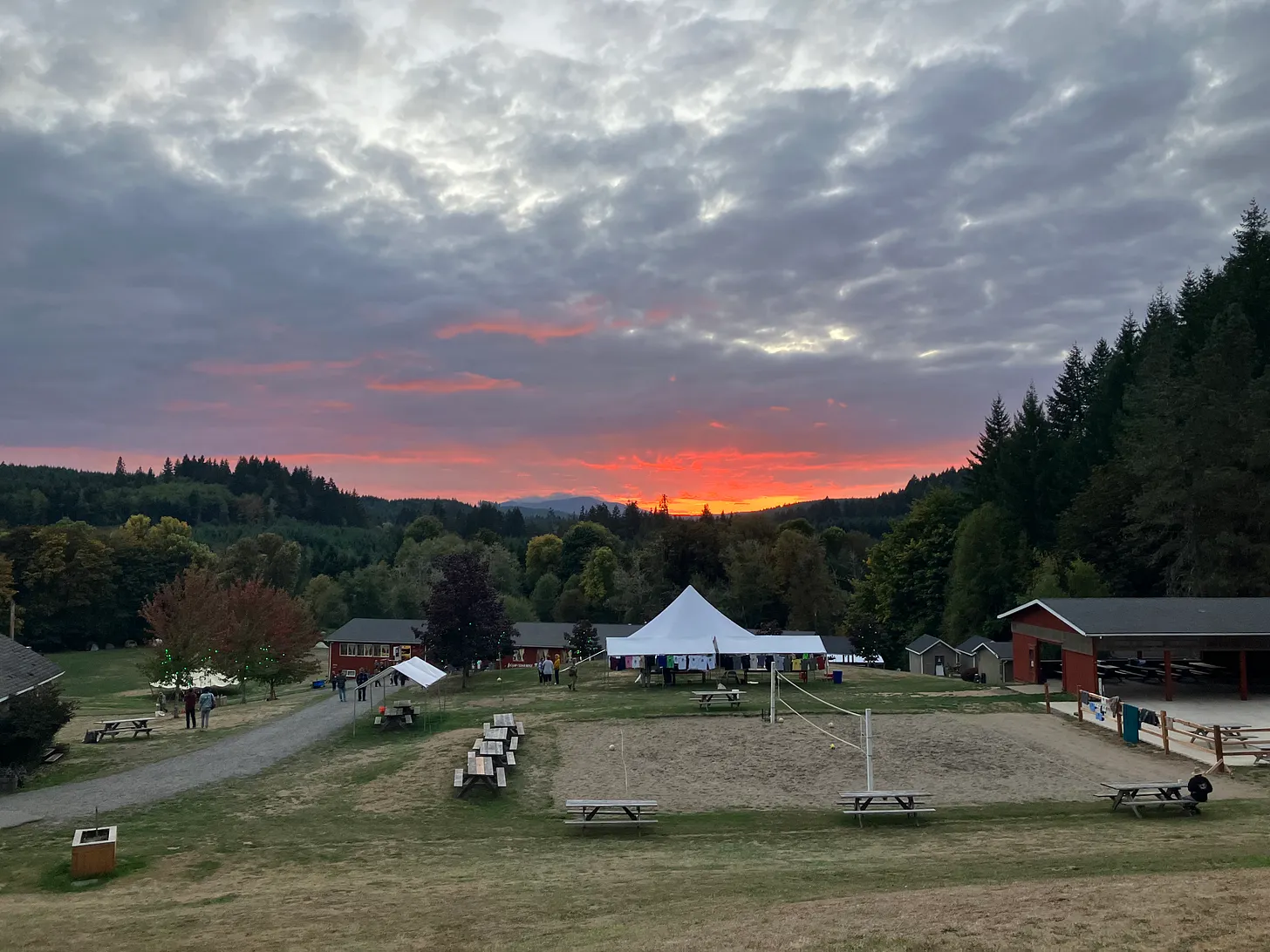
Here is my experience witnessing and working with the energy of bioregional congresses at the 11th Turtle Island Bioregional Congress, held Sept. 15-19, 2026 in the Cascadia bioregion, specifically in the town of Vernonia, Oregon. My intent here isn’t to comprehend or explore the rupture that happened at the Congress, but share one narrative coming into focus for some of us. When things go badly as well as when we work toward repair, there’s a whole lot of complexity and reckoning, and I encourage readers seeking more context to read some of the sources I share at the end of this piece as well as other sources.
Calling on Alice the Kidd
“You awake?” I asked Ken about 5 a.m., 30 hours before the Congress was to end.
“Yes. Of course. There’s no way I could sleep.”
“Then let’s pray to Alice the Kidd,” I told him, both of us already sitting up in bed, exhausted and freaked out, a tough combo for any nervous system.
We were in the middle of Oregon in mid-September at the Turtle Island Bioregional Congress, and also in the middle of a community rupture with no discernible path toward resolution or repair. Our Congress of over 200 people from across the U.S. and around the world was enmeshed in a mess of misunderstandings, not enough orientation to our work together, too little time to get to know each other, too many assumptions, too little listening, and no small measure of pain flooding many if not most of us.
What happened involved a clash between a long-time bioregional congress practice and some of the indigenous people at the Congress. Since the late 1980s, small groups of people spent weeks or months preparing to hold space for the walking, flying, swimming, and rooted species whenever the full Congress met to make decisions or discuss issues. This small group of people—adorned to represent oak trees, red-tailed hawks, or other local species—would quietly perch at the edge of our meetings to observe the proceedings. On rare occasion, and without ever using human words, these representatives would “make a ruckus,” according to David Abram, who brought this practice to the Congress, if the humans were unintentionally making decisions that would negatively impact the more-than-human world.
Unfortunately, this practice sparked division, offense, and pain. The edge of a ribbon shawl (similar to regalia used in Navajo rituals), worn by a woman representing a bird, inadvertently hit a Native woman. Someone else representing a tree, in the wind of exuberance, tossed a pine cone that accidentally hit a sacred drum. These incidents and more led to a meeting of a Congress inter-tribal council with the Congress facilitation team and two of the Congress organizing committee members. Then the council immediately held an unscheduled all-Congress session to address the whole Congress body on why the all species practice was hurtful and offensive. Some who spoke seemed genuinely focused on building bridges to help non-indigenous people better understand their trauma and offense. Some seemed more intent on shaming and shutting down the all species process.
There was no opportunity to clear up any misunderstandings—including that the ribbon shawls, which was not regalia, were lent to two species representatives by Navajo elder, and that species representation was in no way humans speaking for plants or animals.
The resulting criticism left a wake of hurt, shame, anger, and re-triggered trauma, breaking us apart from each other. As Bill Baue writes (see link at the end of this), there were multiple ruptures: “First, Indigenous participants experienced rupture in their perceptions of misappropriation. Next, the broader Congress community experienced rupture from navigating a collective public shaming. And the Indigenous communities within the broader Congress community experienced internal rupture.”
Now, in the wee hours, Ken and I were talking to Alice the Kidd (of course her name doesn’t have a “the” in it, but that’s who she is to me), who died a year ago. One of the magnificent organizers of the third Bioregional Congress in Squamish (in the northern part of the Cascadia bioregion where we now were) in 1988, Alice lived bioregionalism, building community in concert with eco-community in her small town of Yalakom in British Columbia. Unfortunately, she also lived with decades of overwhelming, progressive pain, leading her to finally choose to end her life through Medical Assistance in Dying, legal in Canada.
As Alice prepared for her death, her already very conversational nature led her to become extraordinarily chatty, sharing hard-won wisdom from a life lived close to the land. She wrote of the wonders of her long-term community in Yalakom, reminding us to live with both stubborn hope and curiosity, two qualities we could sure use right now.
“Alice, we are in such a mess here at the Congress. Please help us find some way to healing,” I said.
We slept fitfully afterwards, then went to breakfast, where I found Lauri Kuri, my long-time bioregional friend from Mexico, at an outside table where we downed large mugs of coffee.
“What are we going to do?” I asked. She hadn’t slept well either, both of us seasoned organizers of many a Congress who had tunneled through many messes along the way. But we also understood a lived truth: living for some days with people from all over the continent is often a transformative experience, compounded at this Congress by its shorter-than-usual duration, lack of orientation to bioregionalism, and a shifting schedule that lost hold of many Congress traditions. Moreover, this was the first Congress in 17 years, an enormous gap when it comes to how we used to do things and what’s needed now. Embracing the beautiful wild of the earth among other humans also includes beautiful (and sometimes difficult) wild of human behavior too.
We both knew that such experiences are not for the weak-of-heart. Hard things can and do arise when you intentionally enter into a new way of dwelling with others, if only for four or five days. Over the last 45 years of Congresses (especially ones I helped organize), I’ve certainly seen and have been one of the people crying, walking out, coming back, and finding new ground. Sometimes we need to serve as mediators for others; other times we need mediation….or a hug, a cookie, a long walk through ancient sequoias in British Columbia or along a beach in Maine. When you’re in the middle of hard stuff, it’s difficult to see ways through, and communal tangles can amplify the pain and confusion.
“Find Carmen,” Laura answered just as Carmen Gonzales—a member of the Diné nation and long-time water scientist, organizer, and seeker—walked toward us with her tray of breakfast, ready to talk. We had just met Carmen a few days ago, but already, she felt like someone whose stories of listening to the earth walked alongside our stories, even if I grew up falling in love with trees in Brooklyn, NY; Laura grew up in Satellite City, a progressive and culturally-diverse suburb of Mexico City; and Carmen hailed from the open-skied Navajo reservation and chaotic streets of L.A.
After talking with some of the people most impacted by what had happened last night, Carmen was pondering offering a Peacemaking Circle, guided by the teachings she received from the late Chief Jake Swamp, a revered Mohawk Iroquois leader.
“I slept on it, and I want to offer a Peacemaking Circle,” she said as she put down her tray. “People are hurting.”
With only a day and some hours of the Congress remaining, we knew we had to act fast, so I fetched some of the organizers, Karie Crisp and Bill Baue, and sat them down with Carmen. Laura and I put our arms around each other and walked away. Some kind of healing ground wanted to show itself.
As we went inside to refill our coffees, Laura put into the words the best explanation I had then and still have for what happened: “You have to remember, the Congress is just waking up again after a long sleep. Of course, it is not easy.”
Listening to the Peacemaking Circle
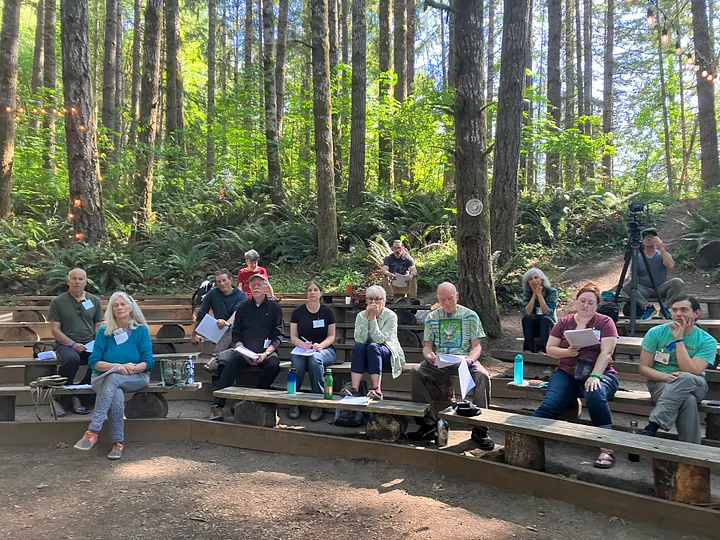
That was breakfast. Right after lunch, the Peacemaking Circle gathered under the main tent, the same place where, 24 hours earlier, things fell apart. As I approached a little late, I saw an inner circle, composed of about 20 people who had been impacted by what had happened: indigenous elders, Congress organizers, all species representatives, and even a young child sitting quietly with her mother. surrounded by the outer circle of the rest of us.
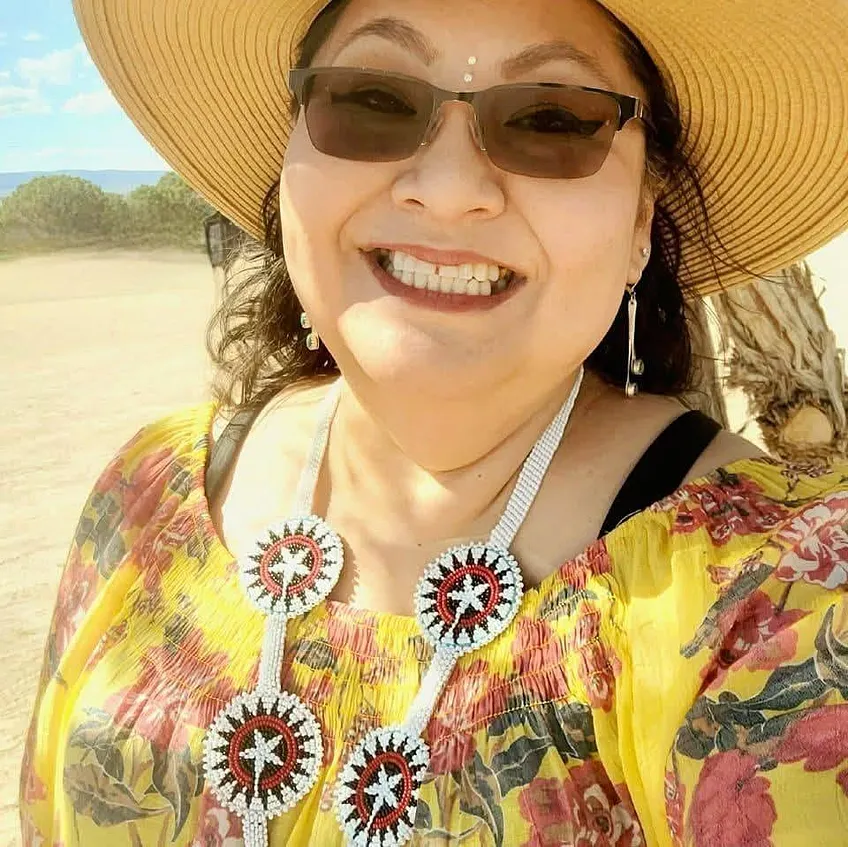
Carmen opened the circle by telling the story of how she, thrilled to see the All Species representation she had read about it in one of Starhawk’s books, gave the women representing birds the shawl, made by Carmen’s mother for her to sell (to help pay her expenses for coming to the Congress). She also shared some of her pain of being unwelcome and outcast at times in both indigenous and non-indigenous communities.
“I am deeply grateful I could bring the remembering of the power of the circle to the Congress,” she later shared. “And I am grateful for all those who sat in circle to honor the dignity and voice of each being who shared from their heart according to the agreements we made with each other before entering the dialogue: listening deeply to hear clearly, honoring each voice without judgment to see clearly, speaking truthfully while honoring the dignity of each being, and speaking only for one’s self to strengthen interpersonal trust and integrity. These agreements, although made quickly due to the emergent nature of the situation we found ourselves in, held the basket of the circle so that we could see each other clearly and listen deeply for the hidden truths that wished to emerge into a more harmonious being.”
After she set the stage, the mic went around the inner circle, allowing everyone five minutes each to talk. In that basket of a circle, I started hearing more to the tone of what people said. Many wanted so much to convey in every ounce of their words how much they loved this earth and how deeply they wanted to do good with each other. There was a kind of music of belonging playing on the channel where most people spoke, especially Carmen, whose voice sounded like a cross between a lullaby and friendly wake-up song, inviting us in so that something greater than the sum of our parts could emerge.
I heard a white woman weep as she talked of how her main companions in this world were the animals in the wild around her solitary home and how she never meant to hurt anyone. I saw an indigenous woman who had been on the other side of the conflict, tears streaming down her face, smile and reach out her arms.
I exhaled and dropped my shoulders. There are so many divides between us, an infinite amount beyond this Congress, so much that keeps us in fight or flight and other forms of hyper-vigilance while species die off, forests burn, floods and droughts overtake watersheds. There is so much broken and not just between us and the more-than-human species. How can these losses, wounds, breaks, and terrors not diminish our capacity to step out of what stories we tell ourselves out of fear and into true presence with each other? Each time we center peacemaking, even and especially if incomplete (which it always almost is) is a step toward wholeness.
Stories from Mexico Renew the Congress Energy
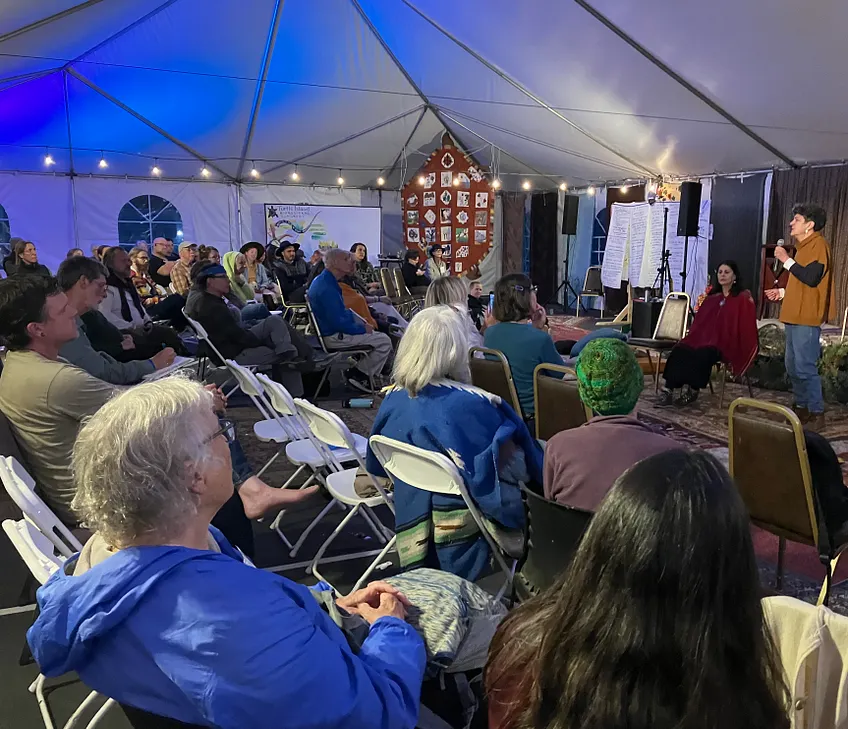
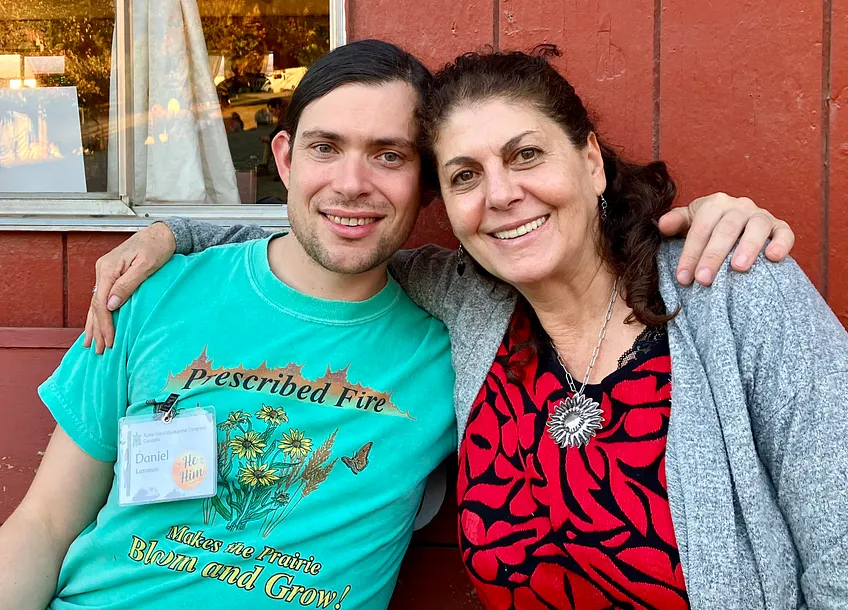
At the same time as the peacemaking circle, Laura was working with some members of the Voice of the Turtle staff and our son Daniel Lassman on finishing the PowerPoint presentation she and Ana Ruiz Diaz, another Mexican bioregional force of nature, brought to the Congress. Earlier in the week, they were told they could have five minutes for what they spent years working on and months preparing, but they were hoping they might find more time.
When I asked people what happened next, most of them say, “I’m not sure.” All we know is that the indigenous presentation that was to happen in the main tent didn’t happen. Laura and Ana’s presentation did. Eslehr Oreste, a Mexican man who divides his time between Veracruz and Vermont, leapt in to arrange the audio-visual components for them. Bill Baue, one of the organizing committee members, helped ensure the presentation happened, then facilitated a lively discussion. Likely, others were involved too. Somehow, most of the Congress participants got the word and streamed in.
More than anything missing from this Congress, I mourned the lack of time in the big tent for cultural sharing nights, a Congress tradition that brought us together to learn about each other and our places via the sensory power of the arts, including poetry, song, stories, film, skits, and dance. I remember our Kansas bioregional group leading a participatory thunderstorm in Texas in 1992, calling on hundreds of people to rub our palms together for soft rain, clap louder and louder and eventually stomp for hard rain, jump for thunder as we collectively built a storm together. We bring our home places alive when we show and tell their stories to others carrying their beloved places in them.
So I was close to tears when Laura and Ana came to the front of the full tent of attendees, the joy in the room palpable as rain after a drought. Laura called me up to read a poem and I read “Inscription,” which begins with “How does time tell our story?”
Time had quite a story to tell about what Ana and Laura brought to life.
Ana told of working decades with many Mexican bioregionalists and traditional communities to ban GMO (genetically modified organisms) corn in Mexico. This effort was rooted in the Mexican Congresses that began in the 1990s—days of stories, music, sweat lodges, and listening to the collective wisdom of what needed to happen next. The lawsuit, filed by 20 different groups, included the Mexican Bioregional Visions Council and vast network of people and groups working in ecological restoration, bioregional education, human rights, and the arts. Guess what? They won with the Mexican Supreme Court recently forbidding planting or issuing permits to plant GMO corn.
While sharing images projected at the side of the tent, Laura told us about a long-term project, spanning several generations, to help over 400 towns empower themselves to protect their land, water, and other sources. Through her and others’ facilitation, they brought together community members, government officials, academic researchers, NGO workers, indigenous people, and land owners to vision a more ecologically-sound future. Bioregional Congresses (called Visions Councils because of the multiple visions involved) especially helped youth step forward into their voices and actions in this ongoing project that extends over geographic Bosque de Aqua, covering a large area around Mexico City.
After a high-energy discussion on how you plant, seed, and grow a movement over decades, Ana and Laura brought us to our feet to sing, “Earth my body, water my blood, air my breath, fire my spirit” in English, and then in Spanish, “Tierra mi cuerpo, agua mi sangre, aire mi aliento, fuego mi espiritu.” The full body of us sang, cheered, held out our arms in gratitude, some of us crying, some of us laughing, all of us finally tucked into the Congress of the Congress.
A Spiral Dance to Turn Ourselves Into a Circle Again
What stays with me most from past Congresses are when the collective we, 150 to 300 people often, stood on the earth in a big circle, holding hands, whether in a clearing near the lush woods in Kentucky or in the middle of a tallgrass prairie camp in Kansas.
Sometimes we have to contort ourselves, bend and stretch in ways that brings us new discomfort or releases old pain, to find our way back to the circle. Yet I’ve thought about and dreamt of these circles so often, reminding me of something whole and holy we can make by simply stepping into place with others.
This gathering was on its way to remembering itself into a living Congress, just in time for our closing ritual, which circled back to Laura and me. This wasn’t out of the blue: for months, Laura and I served on the ritual committee for the Congress, and we had designed and offered many suggestions based on tried and true Congress rituals.
Then in the rapidly developing end game before the Congress, caught in the flux of planning and changing agendas, our original plans disappeared (as did the cultural sharing nights and more). It wasn’t until the afternoon before the end of the Congress that the spiral dance became possible again when one member of the organizing committee members asked if we would lead the closing. Of course we would.
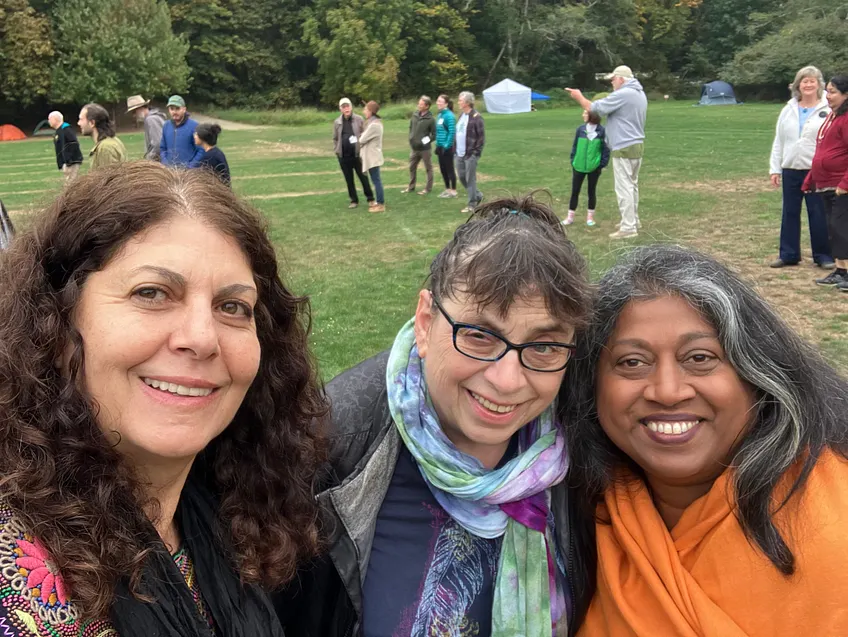
Now here we were at breakfast on Saturday—with help from Ken and the spirit of bioregional Congresses—figuring out what to do. Given how things had gotten contentious in the previous days, we were asked not to have the usual open space in the center of the circle where people could enter and briefly speak.
When we got down to the ritual site, under a tent in a beautiful field, a baby-light rain on and off, we talked about how basking in silence would be an important thing at this moment. People gathered on chairs under the tent or stood around the edges and Laura handed me the mic. First, I called in people who had attended previous Congresses to sit in the center so that we could see more of who had helped make Congresses over the last 40 years happen.
We then shared something intended for the opening ceremony but it also works at any time: the Bioregional Jump. Conceived of by one of the leaders of the bioregional movement, Peter Berg, people circled up, and Ken explained how we would make a literal conceptual leap:
With this jump, I am jumping out of that legal description called Columbia County.
I am jumping out of all those artificially imposed boundaries that obscure the reality of the earth around me.
I am jumping up into the air, out of Oregon, out of the United States, into the mountain winds.
When I land, I am landing on the slope of the Nehalen River watershed that is full of all kinds of life, of which I am a part.
When I land, I am landing in the Coastal Mountain ecoregion, landscapes that hold Douglas firs, sitka spruce, chinook salmon, salmonberry, big leafed maples and western red cedars.
I land in land that drains into the Pacific Ocean.
I am landing on the Earth.
Then with a whoop and holler, we collectively jumped up into the air, landing on our beloved planet, followed by the pronouncement: “Welcome Home”
Ken handed me back the mic, and I said, “We’ve had so many words this week, and although I am a big lover of words, I sense that now it’s time for us to breathe into the quiet together.” I invited us to open the ears of our ears (to paraphrase e.e. cummings) and listen to the earth and to one another in the beautiful quiet.
After a few minutes, I told the story of how, at the the third bioregional Congress, the one Alice helped organize, we ran into a conflict as soon as we circled up at the very start. Starhawk—writer, activist, teacher, witch, and permaculturist—offered to lead a spiral dance according to her spiritual practice, but then Eaglestar, a Lakota elder, offered to lead his people’s version of a spiral dance. After some kvetching and discussion, plus no shortage of exhaustion, frustration, and laughter, we reached a resolution: Starhawk would lead the dance, then Eaglestar would lead the dance.
“That moment was a model for me of how we can come together in many spiritual practices rooted in love of the living earth,” I said.
Laura and I, with Ana’s help, taught people the English and Spanish version of this chant:
We are a circle within a circle with no beginning and never ending.
Somos un circulo dentro del circulo sin principio y sin final.
The thing about a spiral dance is that it starts out just looking like a line of people, led into the open by someone (me in this case). Then the line becomes a circle that winds itself around and around in a tighter and tighter spiral as we sing. Eventually, the people at the center are face to face with each other. It seems at this moment that we can’t step in any further.
In that powerful moment, the leading edge of the spiral changes directions, spiraling out as the rest of the spiral circles in, allowing us to meet face to face and heart to heart.
Holding hands with Laura, who was second in line, I turned around so that I was back to back with her, and gently led her as she led others out, facing each person in turn in the circle. With 150 or so people, it takes a while, but what happens along the way is pure bioregional bliss: each of us looks into the eyes of each of us, one at a time, singing, smiling, sometimes crying, all of us shining in this connection that says without words: I am with you.
By the end, the people at the lead turn back around and lead everyone into one grand circle. In our case, the circle was getting a little wobbly, so thanks to Kanyon Coyotewoman Sayers-Roods, who thankfully stepped in, helped direct people toward spreading out to a true circle.
Once intact as a bioregional circle for the first time in 17 years, we were home with each other, even if it was just before we would break apart, each to our homes in Connecticut, Mexico City, the Netherlands, and so many other places. Now was the moment, however, to name and honor this place. I invited the organizing team to step into the center so we could gesture, call out, or clap our appreciation.
Then, in honor of this place, we ran into the center three times together, calling out, “Cascadia!” before backing way out.
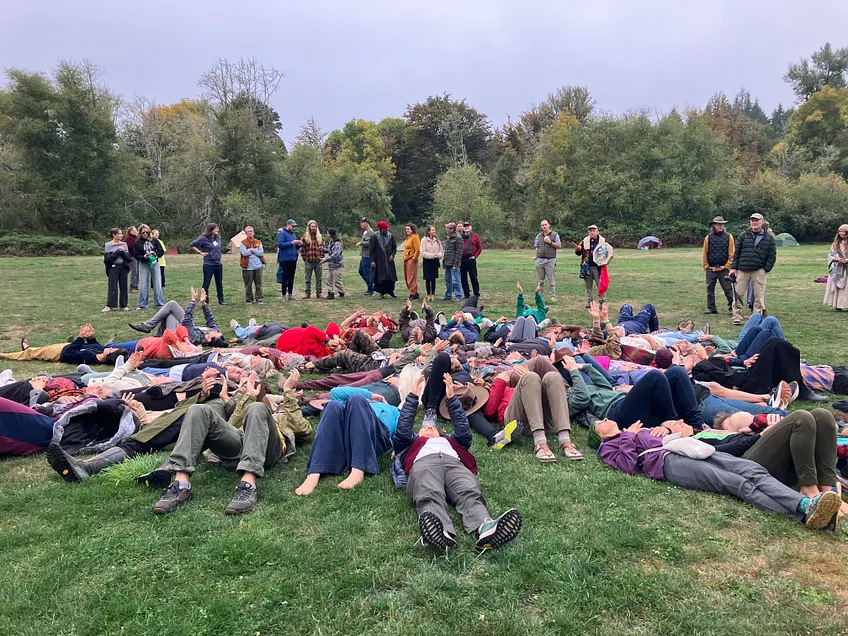
We were complete as this particular Congress but the circle is never broken. Within minutes, I spied dozens of people lying on the ground, shimmied close to each other, while someone played a drum and all the earth-dwellers clapped in time. As Carmen told me after the Congress, “From circles to spirals, this is how our Mother moves from dreaming to creating new worlds.”
The Round Rainbow
There are some who would see this Congress as a failure or success with or in other binary ways. I can’t abide by that because the Congress is a living being. Like all beings, it’s always in motion, sometimes tripping and hitting the ground, sometimes using its innate strength and courage to push itself up again.
I think of what David Haenke, the OG of OGs when it comes to seeding bioregional groups and gatherings throughout our continent, has reminded us of often: Congresses are imbued by a living spirit guiding them and all of us are along for the ride. Like us, Congresses are capable of transformation and growth as well as the opposite. What it takes is remembering to listen to ourselves and the earth.
Which brings me back to Alice’s stubborn hope and curiosity and to rainbows. On Alice’s last day alive in British Columbia, I emailed her from Ireland to share a photo of a rainbow over Galway I took from the train headed toward Dublin. “Rainbows, huh. I will think of them,” she wrote back just hours her life ended.
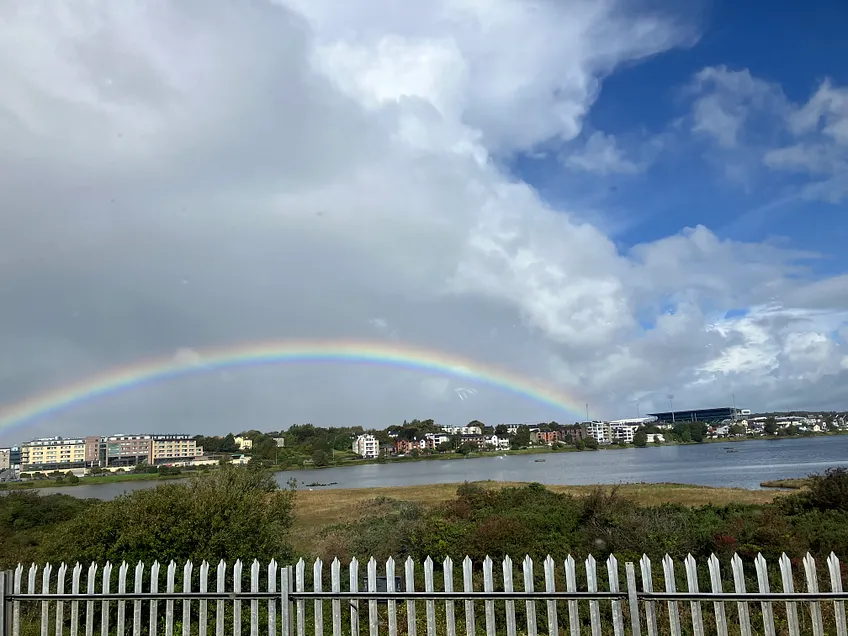
Although there wasn’t a rainbow the last morning of the Congress, there might as well have been one. Rainbows appear, Ken tells me, “when the crying clouds become reflective, spreading the white light from inside each raindrop into all of its diverse components, reflecting back the sunlight from the sun, which has to be below 42 degrees up from the horizon.” In other words, rainbows happen at panoramic moments when we stand between the sun and the rain, illuminating the rain with sunlight that is transformed into an arc of colors. Of course, we can only see part of the rainbow, but if you’ve ever been in a plane flying over a rain cloud, you may have seen a full rainbow, called a glory: a round rainbow.
The thing about the full rainbow as well as the full circle we stood in, is that it doesn’t end. Ken and me, as members of the advisory committee, experienced the Congress starting weeks before we arrived there. In the weeks since, through talking with each other and others on Zoom or the phone or in person, through listening to ourselves and what the chilling air of early October in Kansas tells us, through dreams of still being at the Congress, we are still congressing, despite and because of how hard it was and how beautiful also.
In time we will understand more of what we experienced: the many wonders punctuated with losses and injuries: the vivid workshops among the listening fir trees, deep discussions in small circles in the woods or at picnic tables over oatmeal, the big-group convergences and meetings that happened and the ones that didn’t happen, the peacemaking that unfolded and is still unfolding, the late-night laughter in the living room of one house or on a blanket in the field, the old hurts that surfaced and the new realizations that landed, the reunions with old friends or smiles across the circle with new ones.
“These are the materials,” Adrienne Rich writes in her poem, “An Atlas of the Difficult World.” These and more are our materials from this Congress, patterning themselves over time to come into meaning.
About Bioregionalism and the Bioregional Congress:
The Congresses were sparked into being by a manifesto published in 1976, “Amble Towards Continental Congress,” by bioregional founder and raconteur Peter Berg. At the same time, David Haenke, with organizing magic from people in the Ozarks, organized the Ozark Area Community Congress (OACC), springing to life in 1980; the Kansas Area Watershed (KAW) Council, the second bioregional group on the continent, came into being 18 months later.
Under the auspices of New Life Farm’s Bioregional Project in the Ozarks, with energetic participation from OACC and KAW people, organized the first continental Congress at Lake Doniphan, north of Kansas City, MO., in 1984. From there, Congresses were organized in Great Lakes Bioregion, Michigan, 1986; Squamish, Cascadia, British Columbia, 1988; the Gulf of Maine, 1990; Edwards Plateau, Texas, 1992; Ohio River Valley, Kentucky, 1994; Cuahunahuac, Mexico, 1996; Tallgrass Prairie, Kansas, 2002; Black Mountain, North Carolina, 2005; The Farm, Tennessee, 2009. The name changed from “North American” to “Turtle Island,” a name rooted in many indigenous traditions.
Caryn Mirriam-Goldberg, poet, writer, and former Kansas Poet Laureate, attended her first bioregional Congress—the Ozark Area Community Congress—in 1981, then six months later, went to the first Kansas Area Watershed Council. Her life hasn’t been the same since. Along with KAW Council and OACC people, she was one of the organizers of the first continental Congress in Missouri in 1984. KAW Council folks later resurrected the Congresses after a lapse in the late 1990s and organized the bioregional Congress on the prairie in 2002. Caryn and her husband Ken Lassman, who met at the first KAW Council, went on to co-chair the bioregional Congress council, supporting and mentoring Congress organizers for the next ten years. Caryn, the author or editor of over 25 books, also taught for many years at Goddard College, where she founded Transformative Language Arts and continues to facilitate writing and creativity for groups and individuals. She and Ken live on 130 acres of family land south of Lawrence, Kansas, that they spent decades protecting and were finally able to buy and put in a conservation easement.
Big thanks to the Congress organizing committee, especially Karie Crisp, who carried this Congress into being, and to Lilly Falconer, Clare Brodeur, Bill Baue, and Brandon Letsinger. Bouquets of gratitude to people who helped me remember and contextualize more of what happened (as best I could) of this congress and/or bioregional history: Suzanne Richman, Laura Kuri, Carmen Gonzales, Bill Baue, Denise Henderson, David Haenke, Judy Goldhaft, and especially Ken Lassman (apologies to anyone I forget to list).
For More Context on What Happened at TIBC 11
- Please see the excellent article by Denise Henderson Vaughn, Grisha Stewart, Azul Gregorson, Z Johnson, and Tegan Vaughn in the Sept. 19, 2026 issue of Voice of the Turtle, the Congress’ daily newspaper, here.
- Please read Bill Baue’s superb essay, “The Gift of the Turtle Island Bioregional Congress: Conflict Transformation & Collapse Resiliance,” in his Substack.
- Enhance your life and your understanding of the more-than-humans among us through David Abram’s life-changing books and other writing, which you can find here.
- Check out Regenerate Cascadia, a wonderful site about bioregionalism in Cascadia.
- Watch this short video about the 44-year-old Kansas Area Watershed Council.