Oct 20, 2026 Bill Baue, TIBC organizer
“We must show up with a willingness to transform our conflicts into pathways toward peace… When properly managed, conflict can become an incredible tool for unifying our movements.”—Sherri Mitchell (Weh’na Ha’mu Kwasset—She Who Brings the Light), Sacred Instructions: Indigenous Wisdom for Living Spirit-Based Change, 2018
“TIBC11 was a shitshow.” “TIBC11 was a gift.”
In the wake of the Eleventh Turtle Island Bioregional Congress (TIBC11), these are the far ends of a wide spectrum of participant interpretations of this, the first continental-scale bioregional congress to happen after a 17-year hiatus since their heyday, when continental bioregional congresses convened on Turtle Island every few years from 1984 to 2009.
As with all human affairs, TIBC11 was a kind of Rorschach Test that reflects back each participants’ own peculiar perceptual biases. For whatever reasons, TIBC11 seems to have elicited a particularly potent version of this effect!
In this piece, I share my own experiences of the event: the forms I see in the ink blob, if you will. And I limit my interpretations to what was, not what I wish might have been in an idealized version of the Congress.
Given that I’m a member of the Organizing Team that coordinated TIBC11, as well as of the Core Facilitation Team that held the full collective spaces, I was both privileged to directly experience some situations that impacted how the Congress unfolded, and also burdened by the weight of greater responsibility and accountability. That said, my perspective is not necessarily special – it’s just one amongst ~300.
It would be impossible (and unwise) for me to try to unpack all of the significant dimensions and dynamics that unfolded at TIBC11, so I choose to focus on a particularly relevant cluster of unfoldings that inform the story I tell myself (and that I tell you now) about TIBC11.
My story in a nutshell: Its very shitshow-ness made TIBC11 a gift, as it tested (and continues to test) our individual and collective resilience—which I argue, as you will see, is the single most important attribute of the movement.
Please, come with me now as I journey back to revisit the episodes that inform my narrative.
Sanctuary
At lunch on Thursday—approximately the mid-point of the event—I was approached by a fellow Facilitation Team member with a message that the TIBC11 Indigenous Program Director was inviting us to the Indigenous Sanctuary tent. On the walk over, it was explained to me that the Facilitation Team was to join a circle discussing specific events of the past day. Namely, Wednesday’s Convergence (the daily full-group session for synthesizing shared direction) that featured a practice enacted at many previous continental bioregional congresses, where participants sensed into their connections to the more-than-human world—the winged ones, the water dwellers, the four-leggeds, the mountain and tree beings—and if they felt the stirring, to communicate what they sensed to the full group, without words.
When I entered the Indigenous Sanctuary tent, the Intertribal Leadership Council—a group of Indigenous participants pulled together by the Indigenous Program Director—sat in circle, burning sage, tobacco, and other ceremonial herbs to smudge with, thereby entering sacred space. When I drew the clarifying smoke around my body, I felt my consciousness open, despite (or perhaps enhanced by) the unseasonably hot sun streaming into the tent.
One-by-one, Indigenous relatives shared their perceptions of the previous day’s events. What I heard was a sense that the interspecies practice sought to speak for other species, which troubled many who spoke. Several Council members noted that many Indigenous Tribes have traditional protocols for engaging with animal, plant, and Earth spirits that can only be enacted after years and years of training. But Indigenous practices wouldn’t seek to represent these other beings, who can (and do) represent themselves, one Indigenous participant said.
Another consistent perception was that the shawls worn by those connecting with the winged ones appeared to mimic traditional Indigenous regalia, which felt like a misappropriation.
One Council member’s sharing particularly impacted me: they started and ended their turn taking accountability for how their history of trauma informed their current lived experience, recognizing that this past trauma sometimes overlays their current experience, affecting their perception—and continually inspiring them to actively heal their wounds. I deeply respected what I perceived as personal accountability in the broader context of shared experience.
Another Council member—who conveyed to me when I first met them earlier in the week during setup that their language has no word for hate—continually caught my eye, expressing what I felt as care. When all departed from the tent after the circle came to a close, we hugged, in what felt to me like mutual respect. Indeed, I felt a strong sense of appreciation for how concerns were expressed with respect, humility, and humanity.
Another thing that took me quite a while to process: the circle ended with an implicit sense that the Intertribal Leadership Council would present their perceptions at the full group Convergence Session immediately following (diverging from the planned Agenda, which focused on advancing the Bioregional Action Toolkit), but I don’t remember the Indigenous Program Director (who was leading the circle) ever framing this as a shared decision or seeking collective consent—it felt more like a fait accompli.
Ruptures
The full group Convergence Session starkly contrasted the intimacy of the Sanctuary: it was arranged with the Intertribal Leadership Council on stage, facing the audience of bioregionalists; there wasn’t an attempt to create shared sacred space; and the only voices were those from the Intertribal Leadership Council (and at the end, those they invited from the Core Facilitation Team)—there was no space made for sharing other perspectives, such as those of participants in the interspecies practice.
Much of what was shared in the Indigenous Sanctuary was repeated by Intertribal Leadership Council members, in similarly respectful tones—the positive intentions were clear to me. However, I don’t remember the contextualization of past trauma informing present perception being shared as clearly as it was in the tent; and as the session progressed, the tone took on a sense of shaming, with one Intertribal Leadership Council member using the term “Green Toddlers” to characterize the interspecies practice enacted at the previous day’s Convergence.
After about an hour of the Intertribal Leadership Council’s sharings, an Indigenous relative approached the stage to express disappointment that the members of the Intertribal Leadership Council did not attend the Workshop where she and her colleagues presented on Earth law activism for dam removal (to a relatively small audience) happening at the same time the Indigenous Program Director convened the circle in the Indigenous Sanctuary tent. She experienced this processing of past events, over the concurrent opportunity to express solidarity with Indigenous relatives, as a misprioritization.
The word I started hearing in conversations was rupture—but upon reflection, I believe it’s more accurate to think in terms of ruptures. First, Indigenous participants experienced rupture in their perceptions of misappropriation. Next, the broader Congress community experienced rupture from navigating a collective public shaming. And the Indigenous communities within the broader Congress community experienced internal rupture.
Adding another layer of complexity, many elements of traditional Congresses had been displaced, some consciously to adapt to contemporary contexts, and some due to time slippage (the venue served dinner an hour late the first night, impacting the Opening Orientation, and the next morning, the Opening Ceremony exclusively featuring Indigenous sharings ran very late, spilling over the planned Bioregional Circles and into lunch). The effects of these intertwined ruptures rippled through the community as the rest of the day unwound.
That evening, in an impromptu Organizing Team meeting, we learned that the shawls were gifted by an Indigenous participant to those who donned them: her mother had made the shawls, integrating traditional elements, but not intending the outfits as formal Indigenous regalia. We also learned that some of the interspecies practice participants were deeply impacted by how their actions were perceived and characterized by some members of the Intertribal Leadership Council in the Convergence session.
As well, the other Organizing Team members expressed disappointment that the Indigenous Program Director invited only the Core Facilitation Team to the Indigenous Sanctuary for the council. After all, the Organizing Team holds responsibility for the overall health of the Congress, and also holds the most in-depth knowledge of the interconnected dynamics amongst the many elements of the Congress, while the responsibility of the Core Facilitation Team was bounded to the Convergence Sessions.
When I crossed paths with the Indigenous Program Director late that evening, I briefly conveyed these three things: the Organizing Team’s disappointment at being excluded from the council in the Indigenous Sanctuary; that some of the interspecies practice participants were deeply impacted (one wept for hours by the stream); and that the shawls in question were gifted from a fellow Indigenous participant.
I later learned that the Indigenous participant who gifted the shawls for use in the interspecies practice felt unwelcomed in the Intertribal Leadership Circle – for example, the Indigenous Program Director asked her not to speak on a pre-Congress call where the Intertribal Leadership Circle invited the Organizing Team to attend (to further consider the interspecies practice—but she spoke anyway, which I appreciated, as her contribution made a strong first impression on me); and that her inputs for the Indigenous Matriarchs Keynote Panel were not considered, so she stepped off that Panel. Needless to say, I was deeply concerned to learn of these dynamics, as they also helped explain why she wasn’t present at the Indigenous Sanctuary tent for the circle with the Intertribal Leadership Council and the Core Facilitation Team.
It was she who, at the Opening Ceremony, presenced the dynamic of lateral violence between and amongst Native communities: an internalization of colonization. This term resonated in my consciousness throughout the Congress and into the present, as I do my own sense-making (and as I try to make meaning with others).
It was also she who met with me and a fellow Organizing Team member over Friday breakfast to share about the peacemaking work she learned from Chief Jake Swamp, who passed his prophecy on to her two weeks before he passed away. The prophecy foretold a time of crisis that could only be navigated by Indigenous and non-Indigenous peoples coming together in unity.
(After the Congress, she shared with me the deeper story of her encounter with Chief Jake Swamp, who was providing training on peacemaking as part of a Permaculture Design Course in 2010, which experienced a similar rupture of trust in community between Indigenous and non-Indigenous participants and opened the door to reviving the teachings the Great Peacemaker in current time. When she asked how he handles this, he responded: “I just love them”…)
It became clear to us that the ruptures impacted the full Congress community (seeing as they transpired in the Convergence session context), making it essential to pursue healing and peacemaking at the full community scale as well, to help restore the integrity of our social fabric. She agreed to serve as peacemaker in that day’s Convergence, applying the peacemaking process she had learned directly from Chief Jake Swamp.
Peacemaking
Entering the Congress Court (the space that hosted full-community gatherings) on Friday afternoon, I saw it arranged in concentric circles, a smaller circle of about 20 chairs in the middle, surrounded by a larger circle of chairs for the rest of the 300-odd participants.
The peacemaker calmly introduced the peacemaking process, inviting anyone who felt directly impacted by events in the Convergences of the past 2 days to take a seat in the center circle, and share their mind (speaking only for themselves, not for others) for 5 minutes (I volunteered to keep time with a bell). She noted that traumas and conflicts don’t just go away, and can’t be pushed away or buried; they need to be transformed. She invited us all into this transformative energy.
What impacted me most were the sharings by those who participated in the interspecies practice in Wednesday’s convergence. The person who helped develop and hold this process over years of congressing quietly explained the intention: not to speak for other beings, but to inhabit oneself in ways that open up to sense how the more-than-human world communicates in languages that transcend words.
Another participant, who had sensed into mountain lion energy, shared that all humans have sovereign authority and agency to engage with beings in the more-than-human world, asserting that she would not be shamed out of this right and duty. She lamented for the bioregional movement if it lost this commitment—the inherent relational authority of all bodily beings—and celebrated the power of intercultural and interspecies solidarity if the movement reaffirms it.
One of the women who had worn a ceremonial shawl shared that she wept beside the river after the Thursday Convergence, not out of shame but out of profound sadness for the pain described by members of the Intertribal Leadership Council. She apologized deeply.
The woman who had donned the other ceremonial shawl waited patiently to be the last to share her experience. She explained her deep, lifelong connections to the more-than-human world, and how moved she was to be sensing into the spirit of the winged beings. As with her fellow winged one, she expressed deep regret and sorrow for the pain felt by members of the Intertribal Leadership Council.
As the peacemaking progressed, I felt blessed by the rising transformative energy gracing our shared space:
shame transformed into regret and dignity;
misappropriation clarified as misperception;
and separation shifted toward solidarity.
While many pontificate on the idea of transformation, fewer opportunities exist to participate in actual transformation—I felt honored to collectively experience a real time reconfiguration.
The peacemaking was neither perfect nor complete: for example, there were transgressions of our agreements—one participant consciously disrespected the agreement to honor the time limit; a few transgressed the agreement to speak only for oneself, not for others. Expressions of regret were asymmetric, as apologies went unreciprocated.
For myself, relational trust with a few, nurtured over an arc of time, evaporated over the span of days, and could not be re-established through this single peacemaking process—for that it will take more time, if it’s possible at all.
As well, the peacemaking process with myself is ongoing, as I continue to explore my own accountability for important developments. As the only representative of both the Core Facilitation Team and the Organizing Team present at the council circle in the Indigenous Sanctuary, I feel that I bear particular accountability for how subsequent events played out. The fact that I felt deprived of the opportunity to consent (or dissent) to a conscious and explicit decision for the Intertribal Leadership Council to present their grievances to the full Congress community in the Wednesday Convergence, I nevertheless hold myself responsible for my role in the outcome. This bypassing of conscious consent also deprived us (the Core Facilitation Team and the Intertribal Leadership Council) the opportunity to explore other possibilities – other possible interpretations of the event, other possible perspectives of key actors, other facts possibly hidden from view, other possible interventions besides bringing the issue to the full Congress Community…
All of this I regret, and ask pardon from the Congress community.
Stepping back to consider the bigger picture, I more firmly believe that the peacemaking defined the Congress, transforming its latent potential (had it transpired as planned or as wished) into something far greater—emergent, unscripted, unpredictable, and highly uncertain—gifting us the opportunity to navigate a collapse together and retain (or even revitalize) the integrity of the Congress community, and the bioregional movement. After all, we’re only heading into deeper ecological and social collapses at bioregional and planetary scales, posing existential risk to the continued unfolding of the human story.
Turtle Island Creation Story and Conflict Transformation
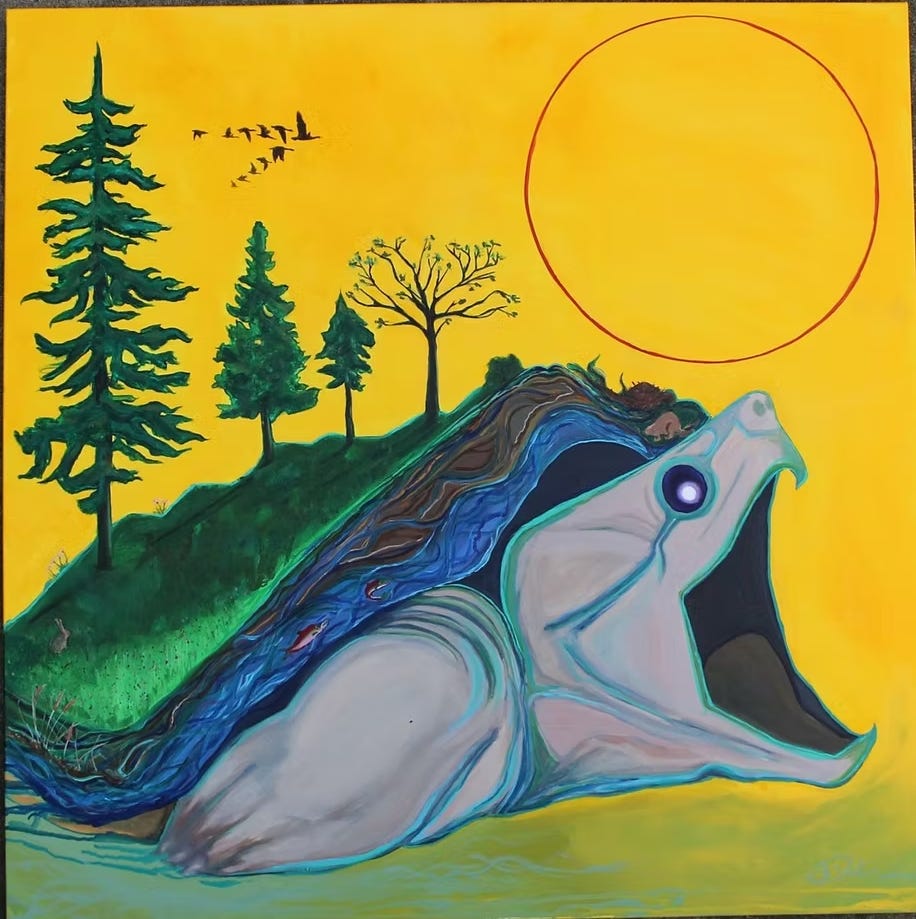
Many Native Tribes carry diverse creation stories of Turtle Island that also share common elements. One element I’ve noticed in versions of these stories (including the Lenape version told by Robert Red Hawk) is Nanapush (a wise trickster who’s also called Nanabush or Nanabozho in other versions) climbing atop a mountain to start the first sacred fire, whose smoke attracted other beings. Creator gifted Nanapush soapstone, from which he fashioned a pipe bowl; sumac, from which he fashioned a pipe stem; and tobacco, a sacred plant.
“Nanapush held that pipe up and told the people, ‘Whenever there’s discord, whenever you hold council, whenever you want to come together, and bring your minds together as one, take this tobacco, put it in a pipe, and smoke it. And that smoke will go into you and when you blow it out your thoughts and your prayers will all intermingle together. And you’ll be able to make decisions that are right for everyone and everything.”
I believe we in the bioregional movement (on Turtle Island and beyond) would benefit from listening to, hearing, and deeply internalizing the transformative essence of this story which asks us to respond to discord by holding council together in order to “make decisions that are right for everyone and everything.”
Making decisions that are “right for everyone and everything” is a very high bar—one that certainly wasn’t achieved at the Congress, as many participants felt (and continue to feel) wronged by the various ruptures and conflicts that emerged. But without that discord, we not would have experienced the opportunity for peacemaking, for healing, for transforming.
In her book Sacred Instructions: Indigenous Wisdom for Living Spirit-Based Change, Penobscot attorney, activist, and author Sherri Mitchell similarly frames conflict as an opportunity for creating cohesion.
“We must show up with a willingness to transform our conflicts into pathways of peace,” she writes in concluding the chapter Grief, Trauma, and Intimacy. The next chapter, Conflict Transformation, presents a counterintuitive perspective on conflict:
“…when facing conflict, our goal should not be to resolve it, but to transform it into a tool for changing our views, relationships, and sociopolitical structures”
“…system-wide transformation must be preceded by personal transformation. Personal transformation is assisted by a willingness to view conflict as an opportunity for healing and growth… Every time we make a new individual choice around conflict, we change the larger patterns of conflict in our lives.”
“Conflict creates friction, friction creates movement, and movement creates change.”
“In order to meet conflict constructively, groups must first establish trust… All this work is founded in trust.”
“When properly managed, conflict can become an incredible tool for unifying our movements.”
Collapse Resilience
Over the past several years, my r3.0 colleague Ralph Thurm and I have been developing a definition of Collapse Resilience that builds on my notion of a Collapse Response Continuum.
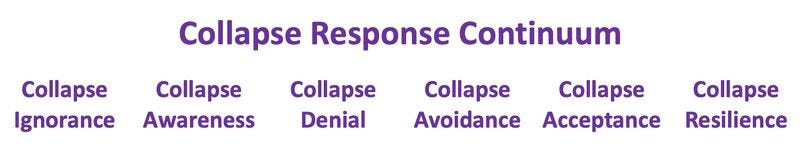
Collapse Ignorance: Unaware of the inevitable ecological and social systems collapses that are impending or already unfolding.
Collapse Awareness: Recognition of the potential for ecological and social systems collapses.
Collapse Denial: After becoming aware of the potential for ecological and social systems collapses, some respond with denial of this potential and/or denial of the impending or unfolding status of these collapses.
Collapse Avoidance: The belief that ecological and social collapses can be averted if we only work feverishly enough (often, within the very paradigms creating the collapses in the first place).
Collapse Acceptance: Coming to terms with the impending and unfolding inevitability of ecological and social collapses.
Collapse Resilience: Recognizing the current inevitability of ecological & social collapses by enhancing resilience that can 1) mitigate the severity of collapses; 2) adapt to emergent post-collapse scenarios; and 3) identify the social patterns that exacerbate & trigger collapse dynamics (such as competition for power), and move away from them (”de-pattern”) by moving toward alternative, prosocial patterns (”re-pattern”) that reinforce social & ecological integrity.
The inevitability of collapse is coded into the DNA of civilization, which is defined by “rigid hierarchical social classes of division of labour, often with a ruling elite and subordinate urban and rural populations.”
“Civilization concentrates power, extending human control over the rest of nature, including over other human beings.”
Goliath’s Curse author Luke Kemp calculates the average lifespan of a civilizational state as 326 years, while the largest civilizational states – “mega-empires covering over a million square kilometers – are more fragile, lasting on average just 155 years.”
As noted above, civilization is predicated on class (and often race and sex) hierarchies, enforced via state monopolization of violence. Interestingly, it is this very partitioning of access to power that dooms civilizations to collapse.
Peter Turchin’s cliodynamic (scientific study of history) database identifies elite overproduction (or competition for limited power) as the single most constant factor in civilizational collapse.
Distilling this dynamic down to its essence: hierarchical power defines civilization; and competition for this concentrated power dooms civilization.
TIBC11 as Collapse Resilience
The term perturbation – which we resilience geeks, like me, relish using – is synonymous with the term that emerged organically at TIBC11: rupture. To riff on the section directly above, the Congress experienced a series of micro-collapses, or tears in the social fabric.
How we respond individually and collectively to rupture, to perturbation, to collapse (small and large) determines our resilience.
Resilience is commonly defined as “the capacity of a system to absorb disturbance and re-organize while undergoing change so as to still retain essentially the same function, structure, identity, and feedbacks.”
In resilience-speak, a “‘basin of attraction’ is a region in state space in which the system tends to remain,” according to a seminal study in the field.
“The people in this system might consider some basins to be desirable and the objective might be to prevent the system from moving into an alternate, undesirable basin from which it may be difficult or impossible to recover.”
And, in the context of collapse, the status quo is so broken that rebounding back to it is insane. Or, in resilience-speak:
“At times societies or groups may find themselves trapped in an undesirable basin that is becoming so wide, and so deep, that movement to a new basin or sufficient reconfiguration of the existing basin becomes extremely difficult.”
“At some point, it may prove necessary to configure an entirely new stability landscape—one defined by new state variables.”
In a study on transformational justice in the energy system published in the Harvard Civil Rights – Civil Liberties Law Review, African-American legal scholar and policy-maker Shalanda Baker coined the term “Anti-Resilience” to describe this scenario.
“Resilience has slipped into the collective consciousness as something to be desired, sought after, a normative good to which communities devastated by horrific events and individuals who have experienced tragedies aspire…”
“However, the idea that we should all merely “bounce back” after experiencing trauma obfuscates important questions: What are we bouncing back into? Are the circumstances into which we are returning unjust or unequal? If so, rather than “bouncing back,” should we not work to remedy the underlying inequities first?”
“Anti-resilience —The quality of resisting the obfuscation of systemic violence enacted upon communities of color and the poor in the name of energy. The act of engaging in a politics of anti-racism and anti-oppression that exposes the roots of structural inequality and vulnerability, and illuminates the path for system transformation.”
The story I experienced about TIBC11 is that its ruptures and collapses gave us a great gift: the opportunity to practice resilience together. Through the intimacy of conflict, we can allow fear or ideological certainty or cultural conceit to divide us. Or, we can express the courage of curiosity and humility to transform conflict into coherence as an act of Collapse Resilience. On the most basic level, Collapse Resilience invites us to mitigate (to the degree possible) the most severe consequences of collapse, and adapt to outcomes we can’t prevent.
The beauty of the bioregional movement, in my mind and heart and soul, is that it’s preferable to status quo societal governance systems regardless of whether ecological and social collapses are averted (which doesn’t seem feasible): it’s a better system any way you slice it.
But on deeper levels, Collapse Resilience interrogates the undergirding civilisational patterns that predictably, systemically, and systematically create collapse, and calls on us to transform those patterns (in other words, to de-pattern.)
And, it calls for us to imagine, instigate, and enliven new, prosocial, life-affirming, nature-loving patterns that cultivate conditions for continual flourishing (re-pattern).
I firmly believe that bioregionalism enacts just that: by its very nature, it deconstructs dysfunctional colonialist, capitalist, extractive, partiarchal, white supremacist civilizational patterns of nation-state governance, and replaces them with healthy, reciprocal, relational, resilient, regenerative, pluriversalist patterns of place-based, place-sourced governance.
The Turtle Island Bioregional Congress gifted the bioregional movement with an embodied instance of active de-patterning, not by avoiding or ignoring conflict, but by actively engaging and transforming conflict through compassionate peacemaking.